English
×
Zamak foundries have long been the backbone of high-precision casting for industries ranging from automotive to consumer electronics. However, as environmental regulations tighten and digital manufacturing accelerates, these facilities are facing a pivotal transformation. This article explores the key challenges in zamak casting today and the innovative technologies reshaping the future of metal production.
Foundries specializing in Zamak alloys face several interlinked operational and environmental challenges.
1. Environmental Sustainability Traditional die-casting methods consume substantial energy and emit significant carbon output due to high-temperature furnaces and intensive material recycling. Managing zinc oxide emissions and waste reclamation is critical, both for regulatory compliance and brand reputation in eco-conscious markets.
2. Cost Control and Resource Optimization Rising energy prices and raw metal volatility directly impact production costs. Since Zamak depends heavily on zinc and aluminum, price fluctuations in these commodities can erode profit margins. Foundries are also challenged to maintain product consistency while reducing scrap and rework rates.
3. Technological Obsolescence Many legacy facilities rely on decades-old die-casting equipment, limiting automation and process data collection. Without modern digital tools, monitoring mold wear, temperature control, or melt purity becomes inefficient — raising defect rates and downtime.
In response to these challenges, zamak foundry and research labs worldwide are integrating digital technology, automation, and eco-friendly practices into their workflows.
Advanced die casting technology is also helping improve process efficiency, precision, and sustainability.
1. Digital Twins and Smart Monitoring The adoption of digital twin technology allows foundries to simulate the zamak die casting process virtually. By analyzing data from sensors in real time, engineers can predict mold failure, optimize temperature control, and reduce energy waste. Example: GF Casting Solutions implemented a smart monitoring system linking mold temperature sensors to digital analytics platforms, reducing defect rates by nearly 18%.
2. 3D Printing for Mold Prototyping Additive manufacturing (AM) is revolutionizing how molds are designed and tested. Instead of relying on traditional machining, precision 3D printing enables rapid prototyping of die inserts and core components from materials compatible with Zamak’s thermal properties. Example: Form Technologies piloted hybrid molds with 3D-printed channels for optimal cooling efficiency — cutting mold fabrication time in half.
3. Sustainable Alloy Development Researchers are exploring modified Zamak compositions incorporating recycled zinc and low-copper variants to reduce environmental impact without compromising mechanical performance. Developments in vacuum-assisted zinc die casting are also minimizing porosity, further enhancing product longevity and recyclability.
Bosch integrated automated closed-loop systems to recycle up to 95% of zinc waste within production lines. This not only reduced material costs but also aligned with the company’s “Climate-Neutral by 2030” initiative.
Bühler developed an energy-efficient die-casting cell, featuring smart cooling systems and precise thermal management to optimize every casting cycle. Their approach demonstrates how incremental process tweaks can lead to large cumulative energy savings.
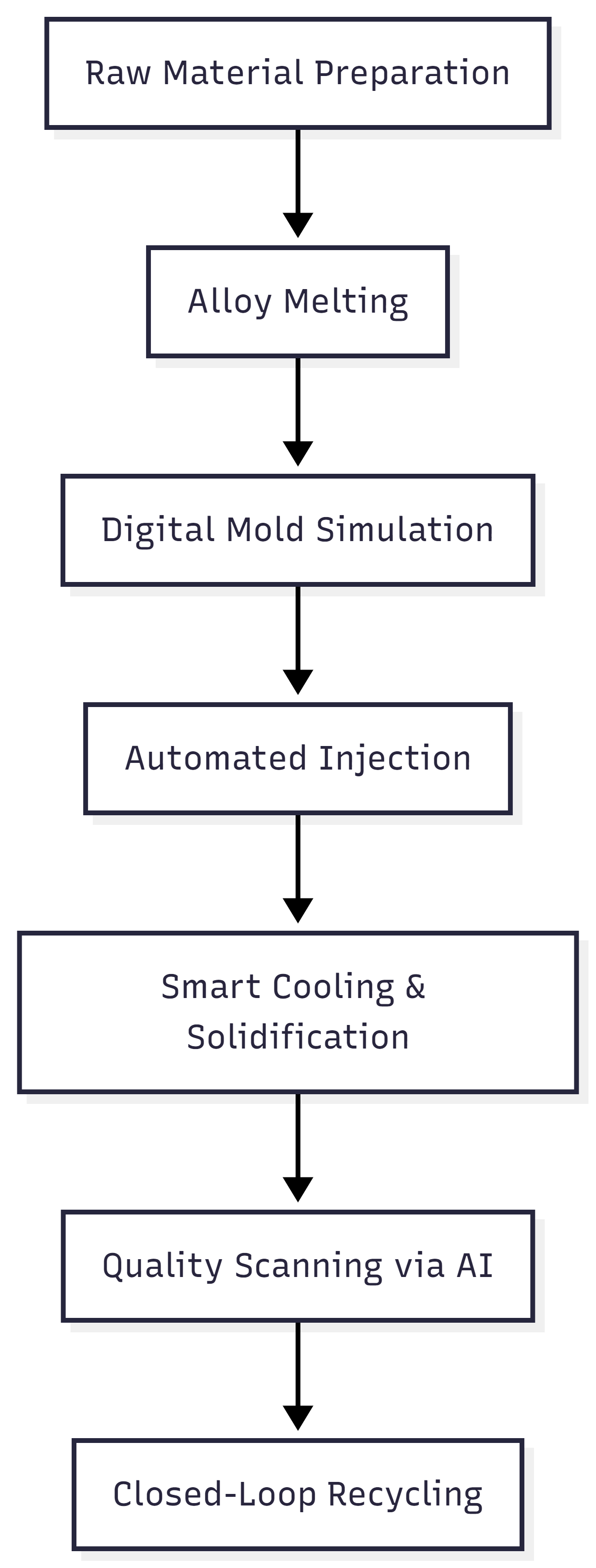
Below is a streamlined flow of the modern zamak die casting process, emphasizing where digital and sustainable innovations integrate:
Zamak Die-Casting Workflow: → Raw Material Preparation → Alloy Melting → Digital Mold Simulation → Automated Injection → Smart Cooling & Solidification → Quality Scanning via AI → Closed-Loop Recycling.
Through such integration of data-driven feedback loops and sustainability initiatives, zamak foundries like Eesson are evolving from traditional production systems into intelligent, adaptive manufacturing ecosystems.
As Industry 4.0 continues to shape the manufacturing landscape, zamak foundries are expected to become smarter, cleaner, and more efficient than ever. The synergy between automation, simulation, and sustainability will ensure that this time-tested metal alloy continues to serve as a foundation for innovation across global industries.
| Know more about Zinc Die Casting at Eesson |
|

Room J757, No. 5358, Huyi Rd, Jiading, Shanghai, China
Room J757, No. 5358, Huyi Rd, Jiading, Shanghai, China